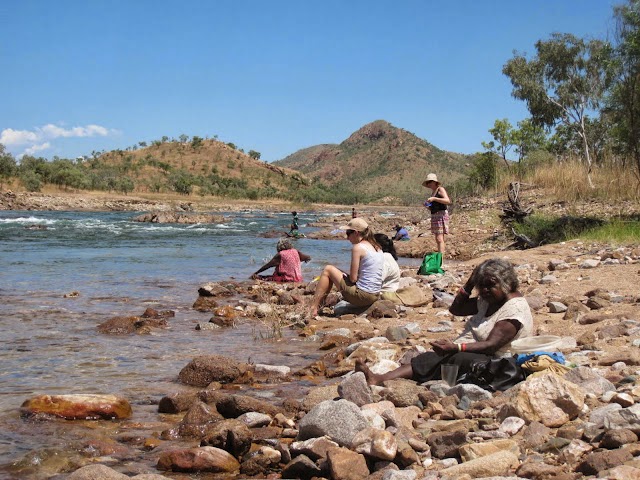
Having been lucky enough to have been involved a few years ago with hands-on documentation of an Australian Aboriginal language up in the Kimberley region of Western Australia, I thought it only appropriate to share a couple of pictures. I was involved in language documentation of the Aboriginal language Miriwoong, spoken in and around Kununurra, WA. These photos are from one of our fieldtrips collecting language data with some of the speakers while they fished.
'A Linguist's Language' has every and all things language. Whether it's new developments in language revitalization, language planning, language learning, or fun quirks about English or other languages, or interesting etymologies, or even information or updates on the status of Australian Aboriginal languages, this site is dedicated to all languages of the world, with lots of (fun) information about almost anything to do with languages and cultures.
Showing posts with label Indigenous languages. Show all posts
Wednesday, March 19, 2014
Monday, August 20, 2012
A cab driver driven by a mission...
A taxi driver working in Greater Kaohsiung, worried that the Hoklo (also known as Taiwanese), Hakka and Aboriginal languages are gradually dying off, has been giving out flyers to customers urging parents to respect their children’s right to inherit their native language by using it with them.“Once you learn how to speak a native language when you are young, it is with you forever,” he said. “Therefore the sequence of language learning should be be oral fluency in native languages, then Mandarin and then a foreign language.” Pan’s intent was to promote the idea that parents should be required to speak in their native language with their children in order to preserve the native languages.
The entire article can be read here
Tuesday, December 20, 2011
Census finds fewer than a half-million Native American language speakers; majority Navajo
More people speak Navajo at home than any other Native American language, a seemingly promising 169,000 people at a time when some tribes have lost their native tongue or are struggling to retain the words of their ancestors. Evangeline Parsons Yazzie, a Navajo professor at Northern Arizona University, said the figure recently released by the U.S. Census Bureau is no surprise, but can be misleading. The country’s population of Navajos is well over 300,000. For every one who speaks the language, one doesn’t — and those are likely younger Navajos, Yazzie said.The loss of Native languages is rooted in a history that includes the federal government’s attempt to eradicate Native American culture by sending children to boarding schools and punishing them for speaking their language. “That’s one thing all Indian nations suffer from,” Yazzie said. “Youth are ashamed of that because it caused a lot of harm. They internalized it. ... Now we’re trying to turn that around and say, ‘The languages are beautiful.’”
Click here to read the full article
Wednesday, December 7, 2011
Indigenous dictionary released on Straddie
A short article detailing the release of an Indigenous dictionary:
"North Stradbroke Island has its own indigenous dictionary, called the Minjerribah Moorgumpin Elders-in-Council Jandai Language Dictionary. The 126-page hard cover book, compiled by The Minjerribah Moorgumpin Elders-in-Council and the Straddie Sand Mining Community Fund, was launched in Dunwich last month. It is published by GEON Group and costs $50 which includes an interactive CD, giving the correct pronunciation to words. Island elder Aunty Margaret Iselin and members of the Minjerribah Moorgumpin Elders-in-Council spent five years on the important task of saving Jandai, the language of the local Quandamooka people. "It might have taken five years to complete, but we now have a timeless record for future generations of our native Jandai language here on Stradbroke Island," she said.
"I was five years old when the two grannies at the Myora Mission decided to teach us the language. The first word they taught was 'myora' which means mission. But after we started learning the language, the authorities came and told us that we weren't allowed to speak it anymore. Now we have the dictionary, the local schools can teach Jandai."
Aunty Margaret worked with family and friends and indigenous residents to write down as many words they could remember in the language. Entries are in alphabetical order and give an English translated meaning. Aunty Margaret said the dictionary came after she found local schools were teaching indigenous languages from other parts of Australia. Mining giant Sibelco developed the Straddie Sand Mining Community Fund to provide financial support for community initiatives on the island.
Order a dictionary on 3409 9723."
Saturday, November 26, 2011
New home movies resurrect endangered Native American language
University of Minnesota Duluth education professor Mary Hermes says saving an endangered language goes beyond just enriching the people who speak it. "I think people have got to get beyond thinking it's just for the Ojibwe people, that we want to save their Ojibwe language. There's 10,000 years of human evolution and knowledge in that language," she says. With support from the National Science Foundation (NSF), Hermes is combining the skills of native speakers with video technology to help others, young and old, learn the language in the most natural way. She's doing it by videotaping short movies of everyday situations, from going to a rummage sale to planting a garden to helping out a sick relative. "Because Ojibwe isn't spoken on a regular basis, there's not a store or a rummage sale or a resort, but part of what we're doing is trying to re-envision what that would be like," explains Hermes.
Thanks to Living Languages where I first read this :)
The rest of this article + (very interesting) video can be accessed here
Thanks to Living Languages where I first read this :)
The rest of this article + (very interesting) video can be accessed here
Tuesday, September 6, 2011
Japanese linguist helps revive an Aboriginal language
In north Queensland the Worrongo language is coming back to life. It's taken 40 years but from almost the ashes of extinction, an Aboriginal language has been saved and is again being spoken on Palm Island in North Queensland. The last living speaker of the Worrongo language is a Japanese professor who created a dictionary after learning it from one of the last native speakers in the early 1970s.
Read the full story here
Saturday, August 20, 2011
Australian project hunts lost indigenous languages
Librarians in Australia have launched a three-year project to rediscover lost indigenous languages. The New South Wales State Library says fragments of many lost languages exist in papers left by early settlers. Before British colonialisation began there in 1788, around 250 aboriginal languages were spoken in Australia by an estimated one million people. Only a few dozen languages remain and the communities number around 470,000 people in a nation of 22 million.
The rest of this article can be read here
Wednesday, August 10, 2011
Federal Agencies Take Action to Digitally Document Nearly 50 Endangered Languages
The National Endowment for the Humanities (NEH) and the National Science Foundation (NSF) today announced the award of 10 fellowships and 24 institutional grants totaling $3.9 million in the agencies' ongoing Documenting Endangered Languages (DEL) program.
This is the seventh round of their campaign to preserve records of languages threatened with extinction. Experts estimate that more than half of the approximately 7,000 currently used human languages are bound for oblivion in this century, and the window of opportunity for high-quality language field documentation, they say, narrows with each passing year.
These new DEL awards will support digital documentation work on almost 50 endangered languages, enhance the computational infrastructure of the field and provide training for the next generation of researchers.
To continue reading this article, click here
Monday, July 25, 2011
Languages on Papua vanish without a whisper
Who will speak Iniai in 2050? Or Faiwol? Moskona? Wahgi? Probably no-one, as the languages of New Guinea — the world’s greatest linguistic reservoir — are disappearing in a tide of indifference. New Guinea is home to more than 1,000 languages — around 800 in Papua New Guinea and 200 in Indonesian Papua — but most have fewer than 1,000 speakers, often centred around a village or cluster of hamlets. The most widely-spoken language is Enga, with around 200,000 speakers in the highlands of central PNG, followed by Melpa and Huli.
More than 200 languages have become extinct around the world over the last three generations and 2,500 others are under threat, according to a UNESCO list of endangered languages, out of a total of 6,000.
The rest of this article/report can be viewed here
More than 200 languages have become extinct around the world over the last three generations and 2,500 others are under threat, according to a UNESCO list of endangered languages, out of a total of 6,000.
The rest of this article/report can be viewed here
Thursday, July 21, 2011
NSW Government announces funding for Aboriginal Language Centre
Minister for Aboriginal Affairs Victor Dominello MP has announced funding for the creation of the Centre for Aboriginal Languages Coordination and Development (CALCD). "I share the view of Aboriginal communities that reclaiming and maintaining Aboriginal language and culture is imperative, as it instills a greater sense of identity, pride and confidence in people and leads to increased school attendance and participation....We have listened to members of numerous Aboriginal communities and we are pleased to redirect funds from the bureaucracy to this community-based Aboriginal organisation to focus on language revitalisation," Minister Dominello said.
To read the rest of the announcement, click here
Friday, July 15, 2011
Saving Language - ABC New England North West NSW - Australian Broadcasting Corporation
LOUISA REBGETZ, PRESENTER: A new push is underway to save the Northern Territory's Indigenous languages. The Northern Territory Library is launching a range of children's books that capture Indigenous stories in Indigenous languages. And in the community of Elliott about half way between Alice Springs and Darwin the new books are having a big impact. Laetitia Lemke reports.
Saving Language - ABC New England North West NSW - Australian Broadcasting Corporation
Friday, February 25, 2011
Languages Of Aboriginal and Torres Strait Islander Peoples - A Uniquely Australian Heritage
This article by Kazuko Obata and Jason Lee, from the Australian Institue of Aboriginal and Torres Strait Islander Studies (AIATSIS), details and describes Australian Aboriginal languages and their features, such as the origin of and relationships between Australian Indigenous languages; creoles; early & recent work in Indigenous language study; the current state of Aboriginal languages & endangerment; and language documentation and preservation.
You can find this informative report here
Subscribe to:
Posts (Atom)