Showing posts with label language documentation. Show all posts

Wednesday, March 19, 2014

Fieldwork pictures

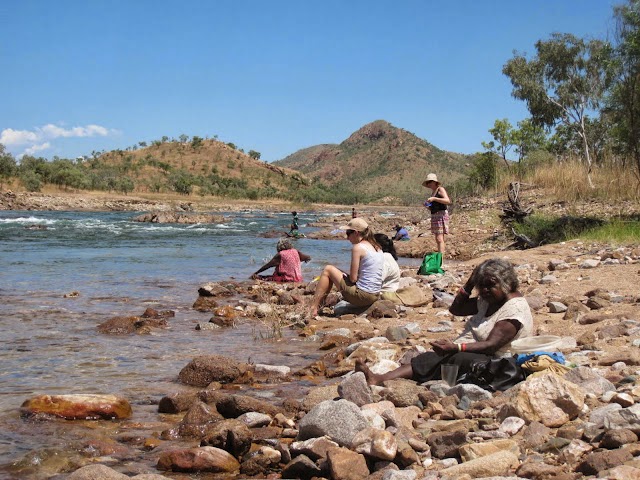
Having been lucky enough to have been involved a few years ago with hands-on documentation of an Australian Aboriginal language up in the Kimberley region of Western Australia, I thought it only appropriate to share a couple of pictures. I was involved in language documentation of the Aboriginal language Miriwoong, spoken in and around Kununurra, WA. These photos are from one of our fieldtrips collecting language data with some of the speakers while they fished.


Tuesday, March 4, 2014

A viewpoint on Aboriginal languages...

A very interesting article recently published on that munanga linguist about some of the author's work being done on dying Aboriginal languages and how they got that way...

Tuesday, July 24, 2012

64 Indian dialects endangered in Mexico

Sixty-four of Mexico’s 364 Indian dialects are at “high risk” of dying out, with less than 100 speakers of each remaining, the head of the country’s National Institute of Indian Languages said Tuesday. Institute head Javier Lopez Sanchez said that in many cases, speakers of dying dialects are dispersed and no longer live in a single community. Lopez Sanchez said many parents aren’t passing their languages on to their children, and in communities in Mexico’s north, Indian children may have a passive understanding of their parent’s language but are unwilling or unable to speak it. “There are entire communities where the children don’t speak their Indian language,” he said. As an example, he noted that among the Yoremes in Sonora state, the remaining speakers are all older than 40. Many of the endangered dialects are in Baja California, and some are in southern Mexico. Click here to read the whole article

Wednesday, April 11, 2012

Keeping Indigenous Languages Alive

The Fort Mojave Language Recovery Program is documenting and rebuilding the Mojave bird song cycle in a partnership between the Fort Mojave Indian Tribe along the Colorado River and Arizona State University’s Center for Indian Education.
Part of the program is dedicated to retaining the Mojave bird songs, which are traditionally songs of celebration. The songs are also part of a larger oral tradition that communicates values and carry lessons of cultural importance to Mojave people, says Teresa McCarty, co-director of the CIE and professor in the School of Social Transformation. One aim of the grant is to document and rebuild the song cycle, which has become less defined with the erosion of the Mojave language. Along with the cultural significance the songs hold, they also contain unique aspects of the Mojave language.


You can read the full article here

Monday, March 12, 2012

Using social media to capture an endangered language

Professor Margaret Noori of Michigan University has created an online community that is capturing, what would otherwise be, a dying language. It’s an innovative way of preserving a language so that ancient sounds are not lost and can be instantly connected with others willing to hear and learn.

The language is that of Ojibwe, Michigan’s indigenous population. As the population who knows this language is continually ageing, it is essential to ‘produce proficiency in the next generation and archive the contributions of fluent elders’. As a result it is the responsibility of the younger generations to learn from older generations. This is why social media is being implemented.

Social media is being used as a linguistic preservation tool, a platform that is very familiar to the young age group. The community is currently using Facebook, Twitter, Flickr and Youtube that will encourage sharing and interaction. So far there are around 450 audio files, songs, lessons and stories to facilitate learning.

This is an example of a new revelation for social media, being used to preserve an endangered language.

This article downloaded from here

Saturday, February 18, 2012

Dual Language Booklet for Native Alaskans Published for First Time

Partnering with a local Alaskan native community, the U.S. Forest Service has for the first time published a dual language booklet in English and a native Alaskan language, Yup’ik, to help educate the greater community in Southwestern Alaska on invasive species.

Titled “Protecting Southwestern Alaska from Invasive Species – A Guide in the English and Yup’ik languages,” the Forest Service’s Alaska Region and the Center for Alaskan Coastal Studies aim to explain invasive species concerns unique to Southwestern Alaska, which is home to a large community of the indigenous Yup’ik people. The title of the booklet translated into Yup’ik is, “Kellutellra Alaskam Ungalaqlirnera Eniaritulinun Itrallerkaaneng – Maaryartekaq Kassat Yup’iit-llu Qaneryaraigtun.”

Protecting Southwestern Alaska from invasive species has proven challenging, not only due to its vast and varied range of landscapes, but also due to difficulties in communication with native Alaskans. About 120 communities, including over 25,000 Yup’ik people, are scattered across this region, and its residents largely use their native languages as their primary means of communication and also continue to follow traditional cultures that are married to the natural environment.

As native Alaskan community members follow subsistence lifestyles and thus depend on natural resources, they are more susceptible to the impacts of the introduction of invasive species. The partnership between the Forest Service and the Center for Alaska Coastal Studies to publish the booklet seeks to increase education and awareness among local residents to ultimately prevent invasive species from being introduced to local Southwestern Alaskan ecosystems.

Report accessed from here

Wednesday, December 7, 2011

Indigenous dictionary released on Straddie

A short article detailing the release of an Indigenous dictionary:

"North Stradbroke Island has its own indigenous dictionary, called the Minjerribah Moorgumpin Elders-in-Council Jandai Language Dictionary. The 126-page hard cover book, compiled by The Minjerribah Moorgumpin Elders-in-Council and the Straddie Sand Mining Community Fund, was launched in Dunwich last month. It is published by GEON Group and costs $50 which includes an interactive CD, giving the correct pronunciation to words. Island elder Aunty Margaret Iselin and members of the Minjerribah Moorgumpin Elders-in-Council spent five years on the important task of saving Jandai, the language of the local Quandamooka people. "It might have taken five years to complete, but we now have a timeless record for future generations of our native Jandai language here on Stradbroke Island," she said.

"I was five years old when the two grannies at the Myora Mission decided to teach us the language. The first word they taught was 'myora' which means mission. But after we started learning the language, the authorities came and told us that we weren't allowed to speak it anymore. Now we have the dictionary, the local schools can teach Jandai."

Aunty Margaret worked with family and friends and indigenous residents to write down as many words they could remember in the language. Entries are in alphabetical order and give an English translated meaning. Aunty Margaret said the dictionary came after she found local schools were teaching indigenous languages from other parts of Australia. Mining giant Sibelco developed the Straddie Sand Mining Community Fund to provide financial support for community initiatives on the island.

Order a dictionary on 3409 9723."

Saturday, November 26, 2011

New home movies resurrect endangered Native American language

University of Minnesota Duluth education professor Mary Hermes says saving an endangered language goes beyond just enriching the people who speak it. "I think people have got to get beyond thinking it's just for the Ojibwe people, that we want to save their Ojibwe language. There's 10,000 years of human evolution and knowledge in that language," she says. With support from the National Science Foundation (NSF), Hermes is combining the skills of native speakers with video technology to help others, young and old, learn the language in the most natural way. She's doing it by videotaping short movies of everyday situations, from going to a rummage sale to planting a garden to helping out a sick relative. "Because Ojibwe isn't spoken on a regular basis, there's not a store or a rummage sale or a resort, but part of what we're doing is trying to re-envision what that would be like," explains Hermes.

Thanks to Living Languages where I first read this :)

The rest of this article + (very interesting) video can be accessed here

Wednesday, November 16, 2011

Fight for Nyoongar language

A QUEENS Park-based Aboriginal group is fighting to preserve the Nyoongar language. The language appears in Western Australian culture, and is featured on street signs, place names and during Welcome to Country ceremonies. However, Nyoongar Language Program interim chairman Joe Collard said such references were not understood and the language was slowly dying out.“Names like Joondalup and Dwellingup – these are our place names that have wonderful histories,” he said. “So many place names across the South-West derive from Nyoongar words, which have associated stories. We could offer these stories to people.” Mr Collard said he was concerned with the low number of fluent Nyoongar language speakers.

To continue reading this article, click here

Friday, October 7, 2011

In the World: Murmurs of Mayan

Along with its stunningly accurate calendar and majestic pyramidal architecture, the Mayan civilization deserves recognition for another unique feature: its language. Mayan languages are a rich source of data for linguists aiming to develop a universal theory of language, but like many of the world’s tongues, their speakers are steadily dwindling in number. MIT undergraduate John Berman spent the past summer in a remote village in Mexico studying Chol — a Mayan language spoken in the southern state of Chiapas — in the hopes of capturing some important features of its grammar and vocabulary. Chol has several elements that differentiate it from English and other well-documented languages, including its manner of expressing possession and the structure of its nouns and verbs.

To read the full article, click here

Tuesday, September 6, 2011

Japanese linguist helps revive an Aboriginal language

In north Queensland the Worrongo language is coming back to life. It's taken 40 years but from almost the ashes of extinction, an Aboriginal language has been saved and is again being spoken on Palm Island in North Queensland. The last living speaker of the Worrongo language is a Japanese professor who created a dictionary after learning it from one of the last native speakers in the early 1970s.

Read the full story here

Monday, September 5, 2011

Workshop works to revitalize Native American - Tlingit - language

Elders, fluent Tlingit speakers, language teachers and learners gathered in Juneau recently to work towards Tlingit language revitalization. The “Honoring Our Ancestors, Teaching Our Language” workshop was sponsored by Goldbelt Heritage Foundation through an Administration for Native Americans language grant; the grant was titled “Tlingit Language Flowing Through Generations: A Region wide Approach to Language Revitalization'.

Teachers work with elders throughout the year enhancing their understanding of the verb forms and then take that new knowledge and translate it into language lessons for youth. Every member of this team is committed to language revitalization and the benefits inherent herein to heal past historical trauma many of our elders experienced from being punished for speaking their first language within schools. Holding on to the language is a crucial endeavor as teachers strive to learn from our fluent speakers.

Read the article in full here

Saturday, August 27, 2011

Cape Cod's first language is spoken again

Imagine helping to recreate the language your ancestors spoke. You have to start thinking like them, even if you don’t have all their words, and even if they did not have to name all the things that you work with today. “There must have been a word, for example, for watermelon,” Nitana Hicks of Mashpee told an audience at Tales of Cape Cod in Barnstable Village this week, but that word had been lost as use of the language died out because of the dominance of white settlers. So, said Hicks, who was talking about her part in a reclamation project for the language of the Wampanoag, she thought that “wet-squash” suited the summer fruit. By agreement of others, then, in modern Wampanoag, “wet-squash” it is. Right now, there is a 7-year-old child on Cape Cod who is being raised with the native tongue as her first language. Hicks said 250 families are enrolled in classes that allow everyone of native descent “to get to the level they want.”

As preliminary work, the language project has created a dictionary, some Wampanoag-based word games, coloring and storybooks, and even a three-day “immersion camp” where only the native language is spoken. A major characteristic of the language that Hicks called “complicated” is that it does not distinguish between genders but does separate “animate” and “inanimate.”

Click here to read the full article

Saturday, August 20, 2011

Australian project hunts lost indigenous languages

Librarians in Australia have launched a three-year project to rediscover lost indigenous languages. The New South Wales State Library says fragments of many lost languages exist in papers left by early settlers. Before British colonialisation began there in 1788, around 250 aboriginal languages were spoken in Australia by an estimated one million people. Only a few dozen languages remain and the communities number around 470,000 people in a nation of 22 million.

The rest of this article can be read here

Wednesday, August 10, 2011

Federal Agencies Take Action to Digitally Document Nearly 50 Endangered Languages

The National Endowment for the Humanities (NEH) and the National Science Foundation (NSF) today announced the award of 10 fellowships and 24 institutional grants totaling $3.9 million in the agencies' ongoing Documenting Endangered Languages (DEL) program.

This is the seventh round of their campaign to preserve records of languages threatened with extinction. Experts estimate that more than half of the approximately 7,000 currently used human languages are bound for oblivion in this century, and the window of opportunity for high-quality language field documentation, they say, narrows with each passing year.

These new DEL awards will support digital documentation work on almost 50 endangered languages, enhance the computational infrastructure of the field and provide training for the next generation of researchers.

To continue reading this article, click here

Sunday, August 7, 2011

Endangered Alphabets

In doing some linguistic research, I came across a fascinating project, called the Endangered Alphabets Project. Fundraising is needed for this project - below is an introduction to it & the full website can be accessed here, at The Endangered Alphabets Project.

The world has between 6,000 and 7,000 languages, but as many as half of them will be extinct by the end of this century. Another and even more dramatic way in which this cultural diversity is shrinking concerns the alphabets in which those languages are written.

Writing has become so dominated by a small number of global cultures that those 6,000-7,000 languages are written in fewer than 100 alphabets. Moreover, at least a third of the world’s remaining alphabets are endangered–-no longer taught in schools, no longer used for commerce or government, understood only by a few elders, restricted to a few monasteries or used only in ceremonial documents, magic spells, or secret love letters.

The Endangered Alphabets Project, which consists of an exhibition of fourteen carvings and a book, is the first-ever attempt to bring attention to this issue.

Thursday, July 21, 2011

NSW Government announces funding for Aboriginal Language Centre

Minister for Aboriginal Affairs Victor Dominello MP has announced funding for the creation of the Centre for Aboriginal Languages Coordination and Development (CALCD). "I share the view of Aboriginal communities that reclaiming and maintaining Aboriginal language and culture is imperative, as it instills a greater sense of identity, pride and confidence in people and leads to increased school attendance and participation....We have listened to members of numerous Aboriginal communities and we are pleased to redirect funds from the bureaucracy to this community-based Aboriginal organisation to focus on language revitalisation," Minister Dominello said.

To read the rest of the announcement, click here

Friday, July 15, 2011

Saving Language - ABC New England North West NSW - Australian Broadcasting Corporation

LOUISA REBGETZ, PRESENTER: A new push is underway to save the Northern Territory's Indigenous languages. The Northern Territory Library is launching a range of children's books that capture Indigenous stories in Indigenous languages. And in the community of Elliott about half way between Alice Springs and Darwin the new books are having a big impact. Laetitia Lemke reports.

Saving Language - ABC New England North West NSW - Australian Broadcasting Corporation

Tuesday, June 21, 2011

Dictionary Of Ancient Akkadian Provides Glimpse Into Civilization’s Cradle

Linguists and researchers of ancient Mesopotamia began compiling the dictionary in 1921. The dictionary, which spans some 10,000 pages in 21 volumes, took no less than nine decades to complete. In the process, it outlived some of the nearly 100 scholars who devoted their careers to it. The final volume, published just weeks ago, caps what editor-in-charge Martha Roth describes as far beyond a mere lexicon. "There are about 28,000 entries in this -- 28,000 words -- that provide a window into the history, culture, and society of the ancient Near East. This was not designed to be a glossary. The entire project sought to explicate the world of ancient Mesopotamia through the words we have preserved," Roth says. Like each reference for each of the dictionary's words, it was discovered on one of the millions of tablets that have survived the centuries. And each line of wedge-shaped cuneiform writing, carved into the clay, has a story to tell.

To read the article in full, click here

Wednesday, April 20, 2011

Ayapaneco language at risk of dying

Anthropologists are racing to compile a dictionary of the centuries-old Ayapaneco tongue, spoken in Mexico. There are just two people left who can speak it fluently – but they refuse to talk to each other. Manuel Segovia, 75, and Isidro Velazquez, 69, live 500 metres apart in the village of Ayapa in the tropical lowlands of the southern state of Tabasco. It is not clear whether there is a long-buried argument behind their mutual avoidance, but people who know them say they have never really enjoyed each other's company.

The dictionary is part of a race against time to revitalise the language before it is definitively too late. "When I was a boy everybody spoke it," Segovia told the Guardian by phone. "It's disappeared little by little, and now I suppose it might die with me." This compiled dictionary is due out later this year.

The rest of the report can be read here, and a full list of the endangered languages of the world can be viewed here; this long list includes languages that are vulnerable, those that are definitely endangered, those critically endangered, & those which are extinct.